Yarn Weight Chart Explained: From Lace to Jumbo
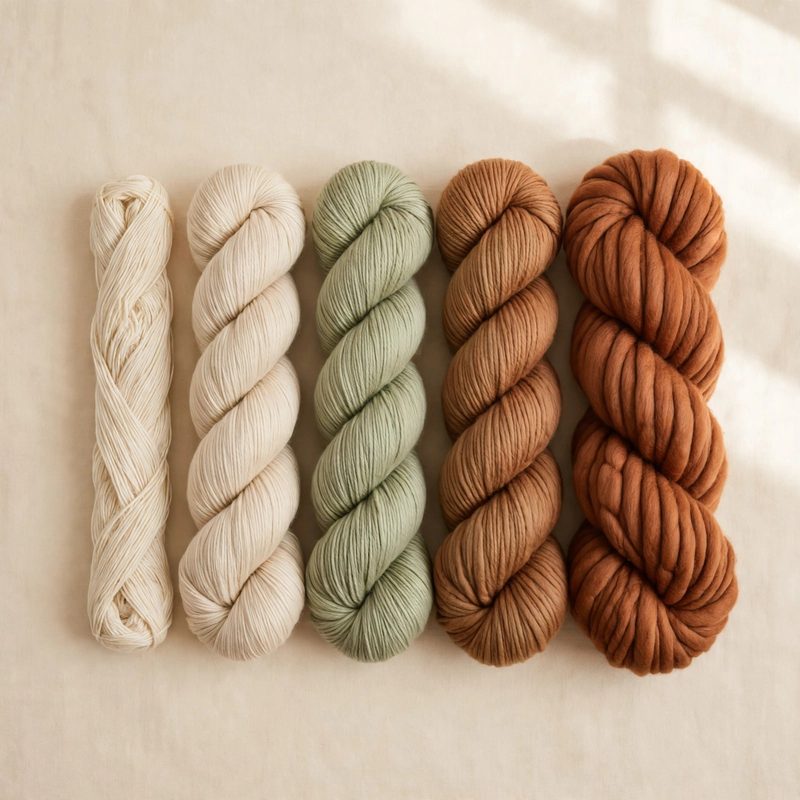
Yarn weight is the single most important number on a yarn label — and the most misunderstood. This guide walks you through the standard 0–7 scale, what each weight feels like, and how thickness changes the yardage your project needs.
What does yarn weight actually mean?
Yarn weight has nothing to do with how heavy a skein is on a scale. It is the thickness of the strand, standardized by the Craft Yarn Council on a scale from 0 (lace) to 7 (jumbo). A 100 g skein of lace weight and a 100 g skein of super bulky weigh exactly the same — but the lace skein holds roughly ten times more yardage.
This matters because patterns are written for a specific thickness. Substitute a thicker or thinner yarn and your finished piece comes out a different size, with a different drape — unless you do the yardage math. Our yarn yardage calculator handles that conversion for you: pick your project and the new yarn weight, and it recalculates the yardage instantly.
The complete yarn weight chart
Here is the full standard scale with typical yardage per 100 g and the projects each weight is best for:
| Weight | Category | Yards / 100 g | Best for |
|---|---|---|---|
| 0 | Lace | 600–800 | Shawls, fine doilies |
| 1 | Super fine / Fingering | 400–460 | Socks, lightweight shawls |
| 2 | Fine / Sport | 300–350 | Baby garments, light sweaters |
| 3 | Light / DK | 250–300 | Sweaters, baby blankets |
| 4 | Medium / Worsted | 200–230 | Sweaters, blankets, scarves |
| 5 | Bulky | 100–130 | Quick knits, chunky blankets |
| 6 | Super bulky | 60–80 | Arm knitting, rugs |
| 7 | Jumbo | 30–50 | Extreme chunky blankets |
Note that different brands vary, so always check the number printed on your own ball band — our calculator lets you enter the exact yardage per skein. If you are still learning to decode labels, see how to read a yarn label.
How yarn weight changes your yardage
Thicker yarn covers more area per yard, so you need fewer total yards — but each skein also contains fewer yards. That is why a throw blanket takes about 2,200 yards in worsted but only 1,400 yards in super bulky: the super-bulky version is much heavier and uses far more skeins by weight.
Rule of thumb: when you move one weight thicker, total yardage drops by roughly 15–20%. Going thinner does the reverse. The calculator's built-in table already accounts for this per project, so you don't have to estimate by hand.
Choosing the right weight for your project
Match the weight to the job. Garments that drape (sweaters, shawls) work best in fingering through worsted. Hard-wearing items (rugs, bags) want bulky and up. Baby items usually sit in sport to worsted — soft and washable beats everything else. And remember that crochet eats about 25–30% more yarn than knitting for the same size; read crochet vs knitting: which uses more yarn before you buy.
Yarn weight vs. WPI (wraps per inch)
WPI — wraps per inch — is the old-school way to measure thickness: wrap the yarn around a ruler and count how many wraps fit in one inch. Lace is 30+ WPI, fingering 19–22, DK 15–18, worsted 12–14, bulky 9–11. The Craft Yarn Council scale replaced WPI on modern labels, but spinners and vintage-pattern users still speak WPI — if a vintage pattern says “18 WPI”, that is modern DK.
WPI is also handy for mystery skeins with no label: wrap, count, and match to the chart above. Then sanity-check with the calculator — pick your project, enter the weight you estimated, and compare the yardage against what you actually have on hand.
Turn this into exact yardage
Use the free calculator to convert what you learned into yardage and skein counts.
Frequently asked questions
Is yarn weight the same as yarn thickness?
Yes. Yarn weight is the Craft Yarn Council's name for strand thickness, numbered 0 (lace, thinnest) to 7 (jumbo, thickest). It is not the physical weight of the skein.
What yarn weight is worsted?
Worsted is weight 4, the medium category — the most common all-purpose yarn. It typically holds 200–230 yards per 100 g and suits sweaters, blankets, scarves, and hats.
Does thicker yarn mean I need fewer skeins?
Not necessarily. Thicker yarn needs fewer total yards, but each skein holds fewer yards too. Check both numbers in the calculator — it reports total yardage and skein counts side by side.
Can I substitute a different yarn weight in a pattern?
Yes, but you must recalculate the yardage and check your gauge with a swatch. See our guide to substituting yarn in a pattern for the exact math.